


Why I Became a Doctor (And Why That’s a Stupid Question)
When you apply to medical school, they ask you the question. The one you’re never really meant to answer honestly.
“Why do you want to be a doctor?”
They tell you not to say “to help people,” or “to make a difference,” or “because I like science and people” — even if those things are true. You’re told to be polished but passionate, strategic but sincere. As if anyone at 17 actually knows who they are, never mind what they want to spend their life doing.
I didn’t have a simple answer then. I still don’t now.
But here’s the truth, or at least the shape of it: I didn’t so much choose medicine as medicine emerged from the wreckage.
Privilege, Pressure, and Performance
I grew up in a middle-class home that leaned toward upper. Private school, stable material life, academic expectations. The kind of environment where success is both assumed and demanded — not out of cruelty, but culture.
I wasn’t neglected. I wasn’t unloved. But I was compared — constantly — to a high-achieving sibling, and that comparison took root.
I was sensitive, theatrical, precocious. I masked. I adapted. I learned to win affection with compliance, cleverness, and charm. I was also neurodivergent, but no one saw it as that then. I just cried a lot and got called “too sensitive” — a pattern that neurodivergent learners often experience in high-pressure academic environments.
The Cliff
At 16, I fell off a cliff.
No, literally.
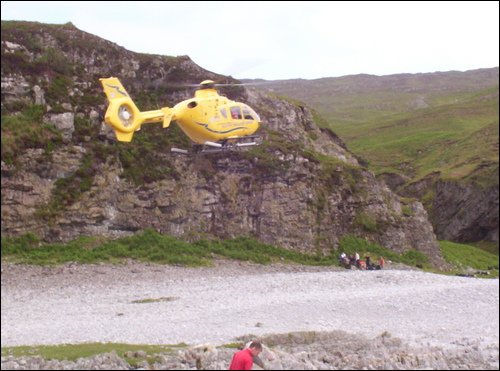
During a Duke of Edinburgh expedition on the Isle of Jura, I slipped while walking up a path that was technically on an OS map.
I fell 30 feet, landed hard, and shattered my pelvis.
I don’t remember the moment of impact, but I remember the pain — white-hot and all-consuming.
I remember my friends screaming, someone holding my hand, blood in my boots.
It took hours to get a helicopter. I lost a lot of blood. I almost didn’t make it - it think. To pull back on accusal of theatrics it was what I was told.
Repeatedly.
I spent weeks in hospital, months in recovery. I went from a healthy, independent teenager to a wheelchair-bound patient learning how to move again. I had plans — festivals, competitions, relationships, a summer that was supposed to matter.
They vanished overnight.
That accident broke more than bones. It broke open something else: a sudden, undeniable intimacy with illness, with helplessness, with care. These kinds of formative disruptions can be pivotal in shaping professional identity in medicine, particularly when they happen before entry into training like mine did.
Better than any work experience you could ask for according to the interview panel at my eventual academic ascension.
Becoming
After I recovered, medicine stopped being abstract. I’d seen inside the machine. I’d seen the staff who were brilliant, the ones who weren’t, the ones who treated me like a body, and the ones who saw me as a boy in pain.
And a shit scary overweight Glaswegian nurse called Brenda who made catheter bags explode with fear.
Her. Her I fucked with for fun.
The end result didn’t make me burn with vocational calling. But it did make me less afraid. And at 17, that’s more than enough to push a decision over the line.
My school was thrilled. My mum encouraged me objectively firmly, subjectively gently. My dad stayed on the sidelines - as he usually did. I had the grades. I did the right extracurriculars. I sat in the big lecture theatre at the school careers fair listening to someone drone on about medical school, not taking in a word of it. But I applied. I got one offer. I took it.
And the rest, as they say, is five years of university, ten years of training, a lifetime of becoming someone who knows how to hold other people’s pain — and just enough of his own to be dangerous.
Would I Choose It Now?
It’s easy to look back and romanticise the whole thing. It’s also easy to get bitter. The truth, again, is somewhere in the middle.
I didn’t enter medicine with a saviour complex. I didn’t even really enter it with a sense of self. I was a clever, confused, masking teenager who had just had his world turned upside down. I was told I’d make a good doctor. I believed them. I tried.
That’s not unusual. That’s not wrong. But it’s not enough anymore.
Medical identity takes time. It evolves, wobbles, fractures and reforms — especially for neurodiverse students whose masking hides more than it reveals. Some don’t realise their divergence until long after training begins.
Now, I Stay
Now, I’m a GP. I teach. I reflect. I rant, blog, collapse, rebuild. I stay — not because I always wanted to be a doctor, but because this is the only thing that’s ever made sense after everything else fell apart.
I stay because I know what it’s like to be the patient who wants his mum in a dark ICU.
I stay because I’ve had doctors save me, and I’ve had doctors ignore me.
I stay because some days, I can be the former.
I don’t romanticise medicine anymore. But I do respect it — not for what it promises, but for what it asks of you.
And if you’re wondering whether to go into it?
Know this: you don’t need a perfect reason. But you’ll need a strong one eventually.
And if that reason doesn’t find you until you’re already in, that’s okay too.
Stay Young
—DW


Comments